
How Does a Spiral Wound Gasket Center Itself?

If you have ever watched a spiral wound gasket being installed on site, you may have noticed something surprising: the fitter simply drops it into the gap between the two pipe flanges, puts in the bolts and starts tightening. No measuring, no marking, no alignment tools.
Is that really okay? A spiral wound gasket (SWG) only seals when its winding sits squarely on the flange’s raised face. If it slips off-center, part of the winding is not compressed and the joint leaks. So why does such a simple, almost careless method work?
1. The Answer Is the Outer Ring
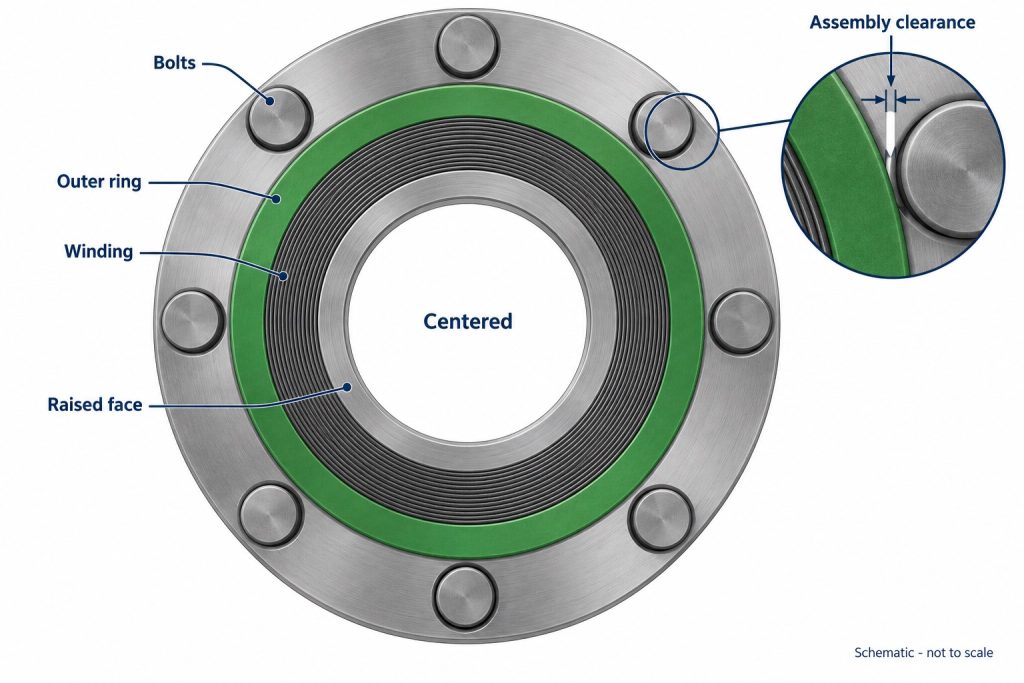
The answer is the outer ring. It is designed to center the gasket automatically, so the fitter does not have to.
Most spiral wound gaskets used on raised-face flanges have a flat metal ring around the outside of the winding. This is the outer ring, also called the centering ring — and as the name says, its main job is to center the gasket.
The outside diameter of the outer ring is made to fit just inside the circle of flange bolts. In simple terms:
Outer ring OD ≈ bolt circle diameter − bolt diameter − a small clearance
When the gasket sits between the bolts, the outer ring touches the bolt shanks all the way around. The bolts hold the ring, the ring holds the winding, and the winding ends up right in the middle of the raised face.
2. How Self-Centering Works During Installation
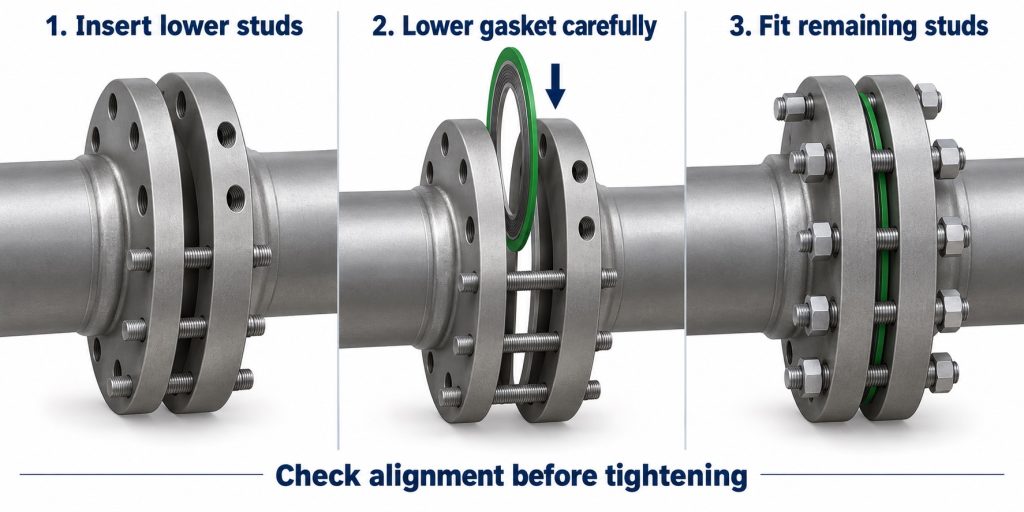
- Insert the lower bolts first. With the flanges slightly apart, put three or four bolts through the bottom half of the bolt holes.
- Drop the gasket in. Lower the gasket between the flanges. Gravity pulls it down until the outer ring rests on the bolt shanks.
- Insert the remaining bolts. With the upper bolts in place, the ring is held from every side and cannot shift.
- Close and tighten. Bring the flanges together and tighten the bolts gradually in a cross pattern.
So the “just drop it in” method is not careless at all. As long as the gasket matches the flange, the bolts do the alignment for you.
3. The Condition: The Gasket Must Match the Flange
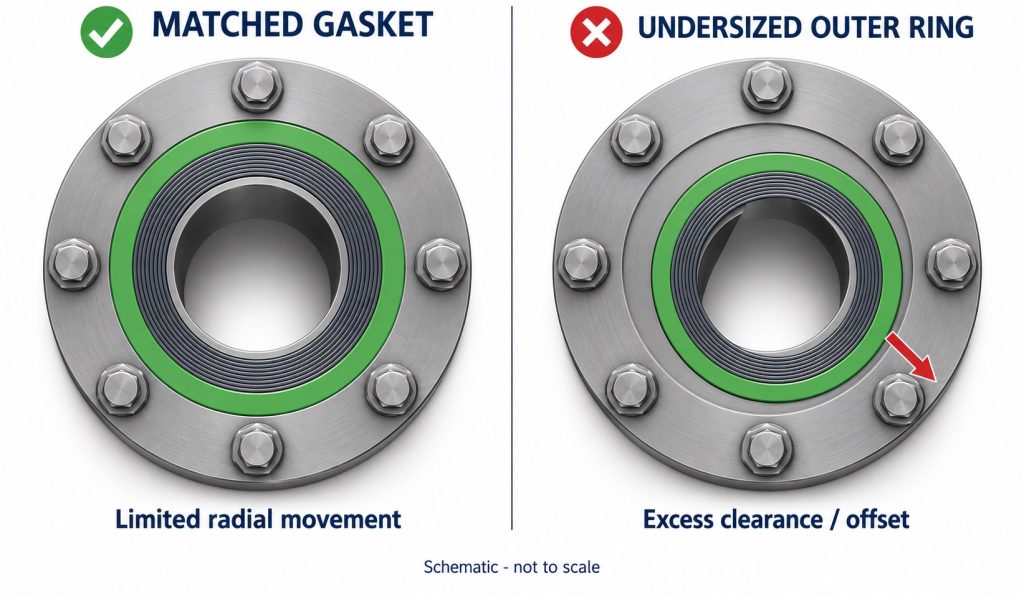
Because the outer ring is sized to the bolt circle, it only centers correctly on the flange it was made for.
- Different pressure classes, different rings. A 4″ Class 150 flange and a 4″ Class 600 flange have different bolt circles and bolt sizes. Their gaskets may have the same winding, but the outer rings are different.
- ASME and EN are not interchangeable. A DN100 PN16 flange (EN 1092-1) and a 4″ Class 150 flange (ASME B16.5) have different bolt circles. An ASME B16.20 gasket will sit loose or off-center on an EN flange, and vice versa.
If the outer ring is too small, the gasket can slide around inside the bolt circle. If it is too large, it will not fit between the bolts at all. Either way, self-centering no longer works.
4. What Happens If the Gasket Is Off-Center?
An off-center gasket causes problems that are hard to fix once the line is running:
- Leakage. One side of the winding hangs off the raised face and is not compressed, which opens a leak path.
- Crushed winding. The other side takes too much load and can be damaged.
- Debris in the line. The winding can be pushed into the pipe bore, where it may unravel and damage valves or pumps downstream.
5. How Are Gaskets Without an Outer Ring Located?

Not every flange needs an outer ring. On tongue-and-groove and male-and-female flanges, the flange has a recess that holds the gasket in place. These flanges use the basic style R (winding only) or style RIR (winding with inner ring), and the recess does the centering.
On standard raised-face flanges, which are by far the most common, you need style CG (outer ring) or CGI (inner and outer ring).
| Flange facing | Recommended style | What centers the gasket |
|---|---|---|
| Raised face (RF) | CG or CGI | Outer ring and bolts |
| Tongue & groove (T&G) | R or RIR | The groove |
| Male & female (M&F) | R or RIR | The female recess |
See our spiral wound gasket product page for available standards and materials.
6. What to Tell Your Supplier
To get a gasket that centers correctly, include these in your inquiry:
- Flange standard: ASME B16.5 / B16.47, or EN 1092-1
- Pressure class or PN rating
- Nominal size (NPS or DN)
- Flange facing: raised face, tongue and groove, or male and female
If you only have an old gasket, send us a photo next to a ruler, with the outer diameter, inner diameter and thickness, and we will match it to the right standard.
Need Spiral Wound Gaskets? Talk to Us
We supply spiral wound gaskets to ASME B16.20 and EN 1514-2, in styles R, RIR, CG and CGI. Send us your size list and flange standard, and we will reply with a quotation.
📩 WhatsApp: +86 187 1010 7193
✉️ Email: sales@felixsealing.com
🌐 www.felixsealing.com