
DDP Sea Freight Orders: What Should Your Supplier Tell You After Payment?

Under DDP (Delivered Duty Paid, door-to-door) terms, the buyer doesn’t have to worry about export customs, ocean freight booking, import clearance, or last-mile delivery — the supplier handles all of it. But that convenience comes with a trade-off: you’re not the one driving the process, so you depend entirely on your supplier proactively keeping you informed.
Sea freight transit times vary a lot depending on origin, destination, and routing — anywhere from a few weeks to well over a month is common. A supplier who goes quiet for extended stretches — even if everything is going fine — leaves the buyer anxious and, frankly, in the dark. Here’s what a supplier who actually has their process under control should be sharing with you, and when.

1. Deposit Confirmed

The moment your deposit is received, you should get confirmation — same day, not “sometime this week.” This is also when the order details (product, spec, quantity, total amount) should be locked in writing.
2. Production Schedule Confirmed
Right after the deposit is confirmed, your supplier should give you a clear production schedule — specific commitments on when production will start and when it will be completed, not vague reassurances like “soon” or “it won’t take long.” A concrete timeline is what you can actually hold them to.
3. Production Started
You should be notified when production actually begins, confirming the schedule from step 2 is being followed.
4. Goods Ready

Once production and packing are complete, you should be told the goods are ready — ideally with photos of the actual finished product, not a stock image or an old photo reused across orders.
5. Shipped (Ex-Factory)
This marks the point the goods actually leave the factory. You should know the dispatch date, even if the goods are headed to a forwarder’s warehouse rather than directly to port.
6. Arrived at Forwarder’s Warehouse
For LCL (less-than-container-load) shipments especially, goods often sit at a forwarder’s warehouse before being consolidated and loaded onto a vessel. This is a step many suppliers skip mentioning — but it matters, because it’s often where delays quietly happen. At this stage, the forwarder can usually provide a logistics tracking link, which your supplier should pass along to you.
7. Vessel Departed
Once the vessel sails, you should receive the vessel name and voyage number, along with an Estimated Time of Arrival (ETA). This lets you follow the shipment’s general progress through public vessel-tracking sites, even though under DDP (door-to-door) terms, the seller handles the Bill of Lading and customs clearance on both ends, so you don’t need to manage that document yourself.
8. In Transit

For longer shipments, a proactive supplier will check in at least twice during transit — even a short “shipment on schedule, ETA still XX days” message. If anything unusual comes up (customs inspection, delays), you should hear about it immediately, not discover it on your own.
9. Arrival & Customs
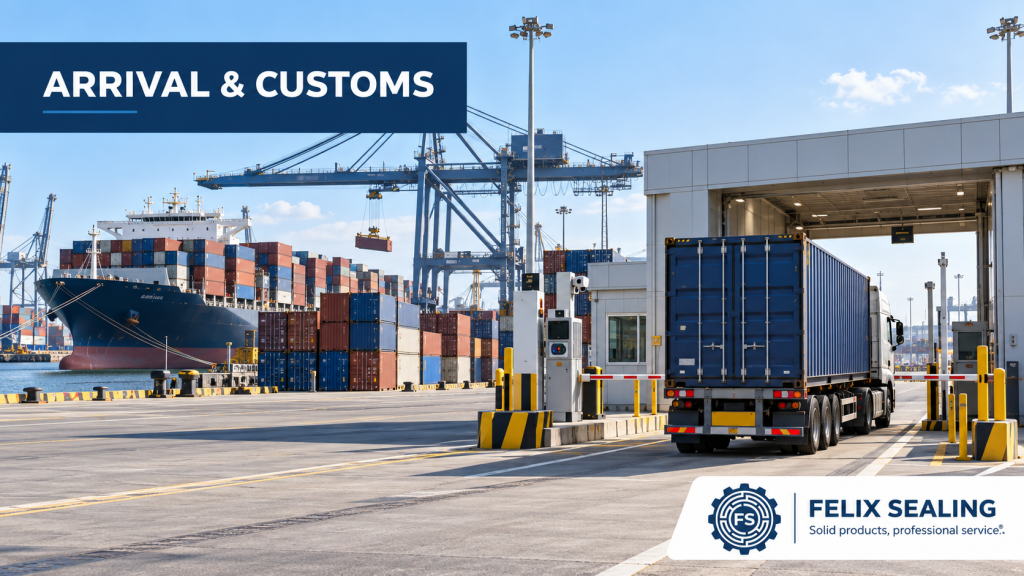
Under DDP (door-to-door), import clearance is the supplier’s responsibility — but you’ll still want to know the shipment has arrived and roughly when customs clearance is expected to finish.
10. Final Delivery

The order isn’t complete until delivery is confirmed — ideally with a signed proof of delivery, or at minimum your own confirmation that the goods arrived in good condition. This closes the loop and is also the natural point for any follow-up on product performance.

How Felix Sealing Works on This
We built this checklist because it’s simply how we run every DDP order (door-to-door, duties & customs included) — not as a marketing promise, but as our internal process:
- Deposit Confirmed → confirmed the same day, in writing
- Production Schedule Confirmed → a specific start date and completion date given right after deposit confirmation
- Production Started → notified once production is underway, on schedule
- Goods Ready → real photos of the finished, packed goods sent to you
- Shipped → dispatch date confirmed
- Arrived at Forwarder’s Warehouse → status update and tracking link shared, even during this often-overlooked stage
- Vessel Departed → vessel name, voyage number, and ETA shared the same day the vessel sails
- In Transit → at least 2 proactive check-ins during the voyage, and immediate notice if anything unusual comes up
- Arrival & Customs → clearance status update, so you’re never wondering what’s happening on the ground
- Final Delivery → confirmation requested directly from you, closing the loop on every order
Why go to this length? Because we’re confident in our product quality — and just as importantly, we want our service to match that same standard. Being professional here isn’t just about looking good on paper; it’s how we build long-term, trustworthy relationships with our customers. It’s how we help you avoid problems before they happen, solve the ones that do come up, and ultimately help you lower costs and improve your margins.
This is the principle Felix Sealing is built on:
Solid products, professional service.
You might also find these articles helpful:
- PTFE Packing vs PTFE Filament Packing — how we approach transparency in material sourcing
- How to Tell Good Gland Packing from Bad
- How to Choose High-Quality Graphite Packing
Have a gland packing or gasket order to place?
📩 WhatsApp us: wa.me/8618710107193
📧 Email: sales@felixsealing.com
🌐 felixsealing.com